Simon Lane Tuckey left Britain as a child to grow up in one of the last outposts of empire, and returned as an adult to establish an enormously successful career at the Bar, on the Bench as both a Commercial Judge and a Lord Justice of Appeal, and then, after his official retirement, as an international arbitrator.
The eldest of three sons of Henry Lane Tuckey and his wife Aileen Rosemary, Tuckey was born in October 1941 at Bamville Wood, a substantial house with farmland just outside Harpenden, not far north of London. There had been farmers at Harpenden since before the Romans came. But Tuckey was born at a time when the settled rhythms of agricultural life, like everything else on the home front, had been up-ended by the Second World War. Tuckey's father was on active service as a Captain in the Hertfordshire Regiment. By the time the second son, Andrew (who went on to become Deputy Chairman of Barings Bank) was born in 1943, Henry had been promoted to Major. He eventually became a Lieutenant Colonel.
After the War, the Tuckeys lived for a time at Elton, in Derbyshire. But before long, the family joined a post-war mini-boom of migration from Britain to what was then the colony of Southern Rhodesia, now the independent Republic of Zimbabwe. Henry and Aileen settled as tobacco farmers at Umvukves (with alternative spellings Umvukwes or Umvukwesi, and now called Mvurwi), in the north-east of the country. The young Tuckey therefore lived through some of the dying days of the British Empire, growing up in a frontier landscape where a rugged and self-sufficient community of white farmer families largely exercised political and economic dominance over a much larger black population. But he and his brothers were educated hundreds of miles away on the opposite side of the country, at Plumtree School near the border with Botswana. So Tuckey's life had already been highly mobile even before he decided to undertake the return journey to Britain to make a career in the law.
As with his Commercial Court predecessor Robert Wright, Tuckey's immediate post-school years are a blank. In an age before it was compulsory for candidates for the Bar to have a degree (that requirement was not introduced until 1971), he dispensed with university, and he is not easily traced until the summer of 1963, by when he was in London reading for the Bar Finals as a student of Lincoln's Inn. He passed with the highest mark of those who achieved a 2.2 classification. This was actually a much better result than it sounds. "Grade-inflation" was not a recognised phenomenon in the 1960's, and only a handful of Tuckey's contemporaries did better than him.
1964 was a memorable year for Tuckey. Not only was he called to the Bar, but he also wed Jennifer Rosemary Hardie. They were married for 59 years until his death, and had two daughters and a son.
Tuckey became a tenant at 4 Pump Court, in the Temple. The set became increasingly well known for commercial litigation during Tuckey's time there, and Tuckey himself – who eventually became Head of Chambers – was an important factor in that. But 4 Pump Court had a very varied workload in the mid-1960's, including crime and a range of civil law disciplines. Tuckey presumably spent his early years at the Bar away from the Royal Courts of Justice, labouring in outlying Crown and County Courts. He did not appear in a case which was considered worth reporting until 1971, and, even then, his name became mangled in the telling: R v Sweet-Escott (1971) 55 Cr. App. R. 318, a perjury case in which "S. L. Tackey" appeared for the Crown. Adding injury to insult, Tuckey lost, though, as some consolation, the judgment recorded that he had conducted the prosecution "very properly".
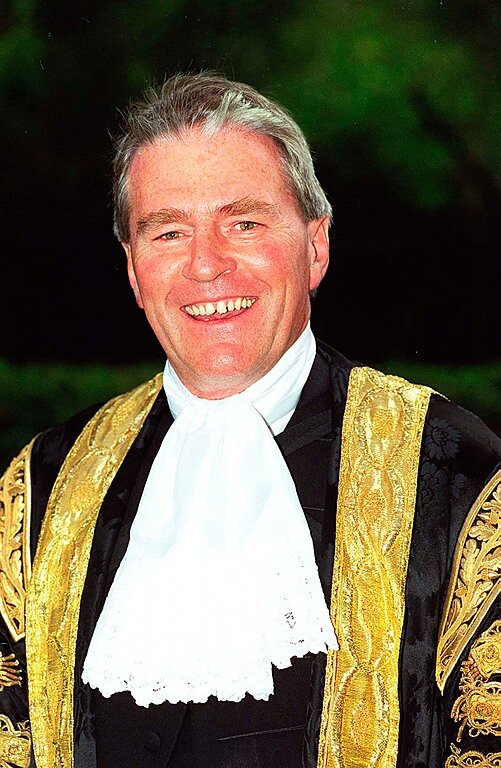
Simon Tuckey In Court of Appeal Robes
Over the next decade, Tuckey was instructed in cases involving agricultural tenancies (Mills v Edwards [1971] 1 QB 379, in which he was "very skilful", "very able", and "very right", but still lost); the eviction of squatters (Warwick University v De Graf [1975] 1 WLR 1126); termination of employment contracts (Treganowan v Knee [1975] ICR 405); trade union rights (Home Counties Dairies v Woods [1977] ICR 463); and consumer credit (Leaves v Wadham [1980] RTR 308. He featured in Lloyd's Law Reports only once during his junior career, in The 'Hilli' [1979] 1 Lloyd's Rep 153, a multi-party off-hire dispute involving an LNG carrier. Tuckey’s most prominent appearances as junior counsel were in Greenwood v Bennett [1972] 3 WLR 691, which established that an owner of stolen goods may be liable in unjust enrichment to an innocent purchaser who improves the goods (a buyer of a stolen car repaired it before the owner repossessed it); and Hollier v Rambler [1972] 2 QB 71, on what constitutes a sufficient "course of dealing" to incorporate one party's standard terms into a contract. Tuckey actually lost both cases. But, more significant than that in career terms was that they were both in the Court of Appeal, and Tuckey argued both without a leader. With advocacy experience of this calibre, he was appointed Queen's Counsel in 1981, after only 17 years in practice.
Tuckey's career acquired more of a commercial emphasis after he became a QC, particularly in the insurance and banking fields. General Re v Forsak [1982] QB 102 established that an insurance contract is concluded as soon as the underwriter initials a slip (although, having won that point before Christopher Staughton in the Commercial Court, Tuckey missed out on the hearing in the Court of Appeal, where Staughton was upheld), and Iron Trades v Imperio [1991] 1 Re LR 213, another success, is still frequently cited on questions of what amounts to affirmation of a contract by a party who is entitled to terminate. But Tuckey continued to be instructed in areas as diverse as gambling and medical negligence, and construction contracts and the recognition of foreign states. Tuckey had good natural attributes for a trial advocate: solid physical presence, a strong and clear voice, and a personality which was affable and persuasive by default, but with sufficient hint of determination behind it to discourage a witness from dishonesty or prevarication.
Alongside his courtroom appearances, Tuckey established a sideline in inquiry work. He represented a company which had manufactured the paint used in the escalator shaft at the centre of the King's Cross Underground disaster, and was retained by British Airways in the inquiry into the Manchester Airport disaster. Presumably it was this experience, together with Tuckey's growing insurance expertise, which led Lloyd's of London to appoint him to investigate underwriting in the insurance market after heavy losses in the early 1980's.
Tuckey became a Recorder in 1984, sitting as a part-time Judge in both criminal and civil cases. His decision in Palmer v Durnford [1992] QB 483 about the scope of expert witnesses' immunity from suit, attracted significant attention at the time, and was regularly cited until the Supreme Court completely restated the law in Jones v Kanay [2011] 2 AC 398. A full-time judicial post followed when Tuckey was appointed to the Queen's Bench Division in 1992.
Just as commercial law had never been the exclusive focus of Tuckey's practice at the Bar, so he did not confine himself to the Commercial Court on the Bench. In fact, he did not sit there at all for the best part of a year after his appointment, during which time he was largely occupied by criminal cases on Circuit and in the Criminal Division of the Court of Appeal. Even when he began sitting in the Court, his appearances were fairly sporadict for a while, as a result of other judicial committments. Tuckey became a member of the Employment Appeal Tribunal in 1993, and was a Presiding Judge from 1995 to 1997, an administrative role which took him out of London for part of the time. But he was then appointed Judge In Charge Of The Commercial Court, and sat in the Court for most of his last year as a first instance Judge. Overall, just under a third of Tuckey's reported cases from his time in the Queen's Bench were in the Commercial Court. They included Fletamentos v Effjohn [1995] 1 Lloyd's 311, in which Tuckey concluded that it is proper for arbitrators to appoint an umpire before the hearing, and for the umpire to attend the hearing as an observer, even though the umpire has no formal function unless and until the arbitrators become deadlocked. He presided over the first trial in The 'Apostolis' [1996] 1 Lloyd's 475, a long-running saga devoted to determning what caused a cargo of cotton to catch fire in the ship's holds, which involved two outings to the Court of Appeal and produced some questionable judicial comments about the limits of unseaworthiness. Most prominently, he tried The 'Star Sea' [1995] 1 Lloyd's Rep 651, a key case on good faith in insurance contracts and on the question of whose knowledge should be attributed to the insured if the insured is a company. The case reached the House of Lords ([2003] 1 AC 489), which disagreed with Tuckey's view that the insured shipowning company had had "blind eye knowledge" that the ship was unseaworthy. Tuckey's judicial personality was patient, courteous, and conscientious, and he was well-liked and respected as a Judge
Outside the Commercial Court, Tuckey was a member of the Divisional Court which held that a Minister's decision not to grant a posthumous pardon to Derek Bentley was open to judicial review and ordered the Minister to reconsider: R v Secretary Of State, ex parte Bentley [1994] QB 349. Bentley was pardoned later the same year. Tuckey's Commercial Court predecessor Rayner Goddard had been the Judge at Bentley's trial thirty years before.
Tuckey was appointed to the Court of Appeal in 1998, when John Hobhouse's elevation to the House of Lords created an opening for a Lord Justice with commercial experience. But Tuckey continued to show that he was not a narrow commercial specialist. More than half of his cases in the Court of Appeal were criminal, and he also sat on appeals involving companies, employment, family law, insolvency, intellectual property, land, personal injury, planning, public law and local government, taxation, and trusts. His call (in company with Andrew Longmore) for a relaxation of outdated judicial attitudes to the construction of arbitration clauses in Fiona Trust v Privalov [2007] 2 Lloyd's Rep 267 was ringingly endorsed by Lord Hoffmann and his colleagues in the House of Lords ([2008] 1 Lloyd's Rep 254). On the other hand, his entirely orthodox conclusion in The 'Achilleas' [2007] 2 Lloyd's Rep 555 that losses caused by a breach of charterparty were recoverable in damages if they fell within the scope of the rule in Hadley v Baxendale fell victim to one of Lord Hoffmann's more perplexing interventions in commercial law ([2009] 1 AC 61). But Tuckey was upheld again in The 'Jordan II' [2003] 2 Lloyd's Rep 87 ([2005] 1 WLR 1363, House of Lords) on the scope of the carrier's obligation to load the cargo under the Hague/Hague-Visby Rules. The 'Epsilon Rosa' [2003] 2 Lloyd's Rep 509 explored new territory in relation to the incorporation of charterparty arbitration clauses into bills of lading, while The 'Kastor Too' [2004] 2 Lloyd's Rep 199 analysed the boundary between actual and constructive total loss in marine insurance. In one of his more eye-catching non-commercial cases, Tuckey took an excursion into the world of the Dutch Masters, holding that Christie's were not liable in conversion for having briefly handled a painting which they had not realised was stolen goods: Marcq v Christie [2004] QB 286.
Retiring from the Bench early in 2009, Tuckey promptly embarked on a third phase of his legal career, as an in-demand commercial arbitrator. Rather than returning to 4 Pump Court, he chose the set at 20 Essex Street as his base, although the international nature of his new practice meant that much of the work was done outside the UK altogether. His roster of appointments in large-scale disputes, testament to the legal profession’s high regard for his abilities, included arbitrations about Far Eastern television services, pharmaceuticals, the development of ports and harbours in the Middle East, the international fertilizer trade, and sales of scrap metal. From time to time, his Awards came before former judicial colleagues in the Commercial Court, on challenges under the Arbitration Act. He still sat judicially himself on a few occasions, helping with the workload as a "retread" in the Court of Appeal. Indeed, it was during his official retirement that Tuckey experienced one of his greatest judicial triumphs, when his dissenting judgment in Kookmin Bank v Rainy Sky [2011] 1 Lloyd's Rep 253 was enthusiastically endorsed by the House of Lords: [2011] 1 WLR 2900. The case remains a leading authority on the role of business common sense in the interpretation of commercial contracts. Tuckey also sat for a spell as a Judge of Appeal in Gibraltar. He did not take up full-time retirement until 2018.
After his 10,000-mile round-trip from the south-east of England to the south-east of Africa and back in his youth, Tuckey almost completed a full geographical circle in his later life. His last London home was in High Point, a pair of Grade I listed 1930's apartment blocks, designed in the international style and built at Highgate, at one of the most elevated locations in the capital. Highgate is known for its panoramic views over London looking south, out over over Hampstead Heath and Regent's Park and down to the Thames. But it is only about twenty-five miles in the opposite direction to Bamville Wood, where Tuckey had been born, though the farmland has been heavily redeveloped since 1941. Simon Lane Tuckey died at home in August 2023, a few weeks before his 82nd birthday, and about a year short of his diamond wedding anniversary. He was buried in Highgate Cemetery.