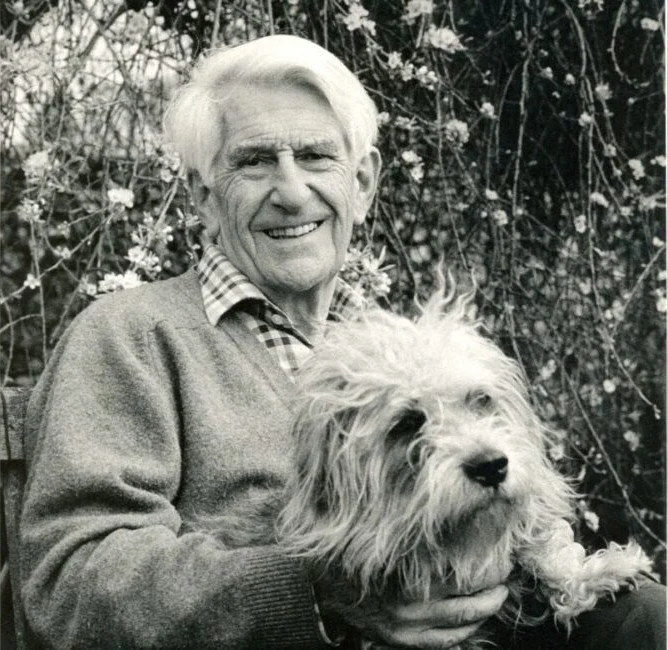
Anthony John Leslie Lloyd's long and active life was distinguished not only by professional eminence at the Bar and on the Bench, but also by tireless work in the service of a host of organisations in a wide variety public and charitable spheres. An almost exact contemporary of Michael Mustill at the Bar, in the Commercial Court, in the Court of Appeal, and as a Law Lord, the quietly understated Lloyd was a little prone to be upstaged by his more extrovert colleague. But in the end, he exceeded Mustill and every other Commercial Court Judge to date by living to celebrate his ninety-fifth birthday.
Tony Lloyd, as he was usually known, was born in Cheshire in 1929. He was the only child of Edward Liverpool department store manager John Boydell Lloyd and his wife Leslie (born Leslie Johnston Fleming). Edward had been born in Glasgow, but he settled in Merseyside after surviving the Great War as a Royal Naval Volunteer Reserve officer in the Royal Naval Division, which was formed to fight on the Western Front when the number of enlisted sailors exceeded the fleet's needs. Tony Lloyd grew up in Neston, on the Wirral Peninsula, and began his schooling in Oxford. Academically brilliant, he won a King's Scholarship at Eton College, where his friends included future Foreign Secretary Douglas Hurd, another King's Scholar. Lloyd also did well outside the classroom: fit and well built, he played for Eton's football team and participated in the idiosyncratic Wall Game, though his true sporting strength was as a long-distance runner. After two years’ compulsory National Service, which he served as a junior officer in the Coldstream Guards, Lloyd joined Trinity College, Cambridge, as a classics student. Again, he excelled: he secured another scholarship, won university prizes for Latin composition, and obtained a first class in his first-year examinations. Then he switched to law. In spite of that academic upheaval, Lloyd still found time for running. He represented Cambridge in the mile at White City in 1950. But he unfortunate in his opponents: Roger Bannister, who ran the first four-minute mile a few years later, won the race for Oxford.
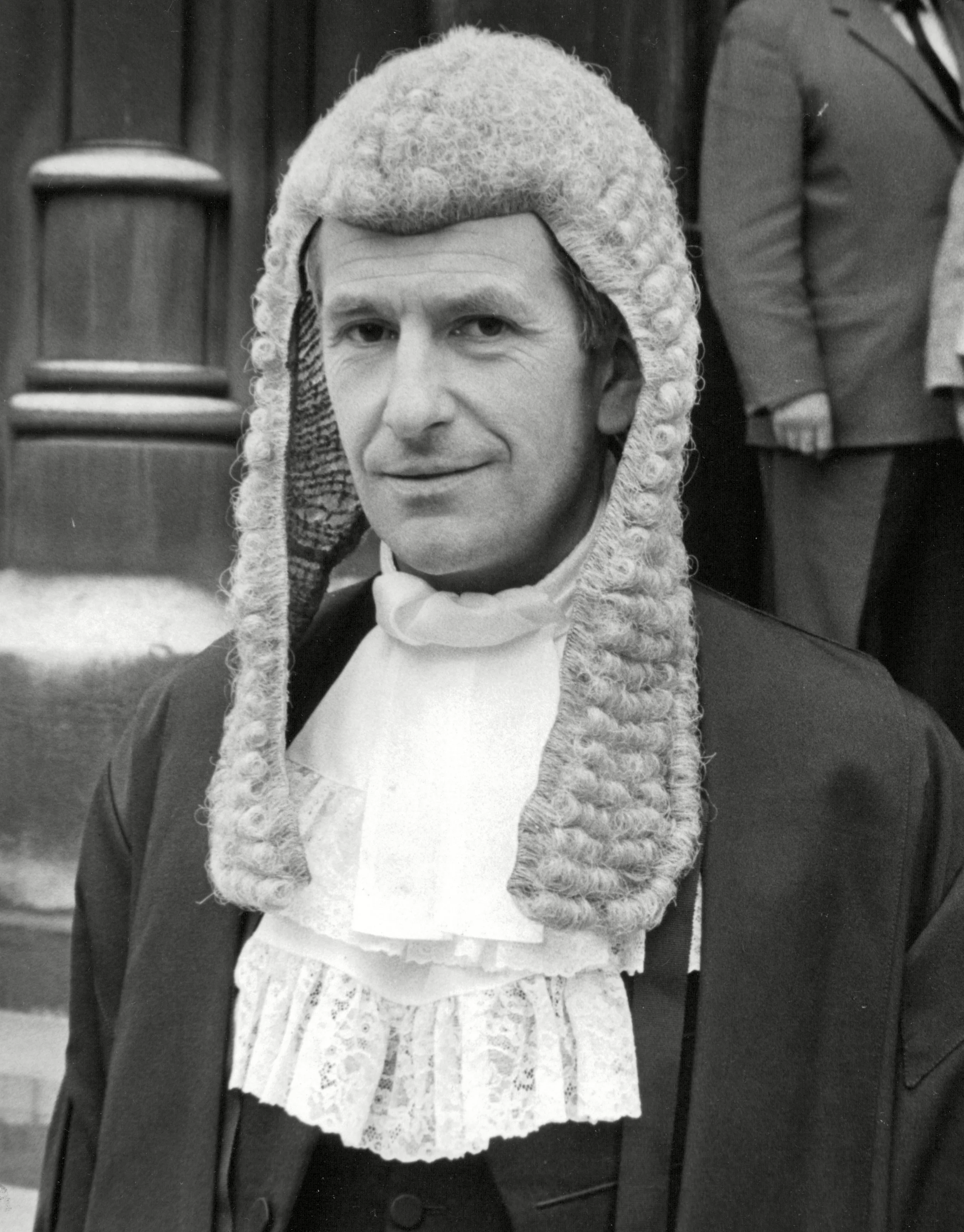
But, while Lloyd had to live with defeat on the racetrack, his run of intellectual success continued. His late start on the law course notwithstanding, he graduated from Trinity with first class honours in law in 1952, then continued his studies in the United States as a Choate Fellow at Harvard. When he returned to Cambridge as a Research Fellow at Peterhouse College (he was the College's first Law Fellow), he seemed likely to follow the academic career path for which he was so obviously suited. In the event, however, he was called to the Bar in 1955 and when his Fellowship term expired, he joined 3 Essex Court. He arrived there at the same time as Mustill, who was younger by two years and one day, but had spent less time in academia. (Ironically, it was Mustill who ultimately achieved the academic acclaim for which Lloyd had looked destined. He was elected a Fellow of the British Academy for his contributions to legal scholarship as editor of 'Scrutton On Charterparties' and 'Arnould On Marine Insurance' and, in particular, as originator and lead co-author of 'Mustill & Boyd On Commercial Arbitration'. Lloyd wrote nothing of substance on law outside his judgments, although he was a recurrent letter writer to The 'Times' while he was at the Bar.)
3 Essex was the pre-eminent commercial chambers, with five future Commercial Court Judges among its existing tenants: Alan Mocatta, John Megaw, and Eustace Roskill were all QCs, while John Donaldson and Michael Kerr were the set's leading juniors. Its members were involved in practically every commercial of the day. But that was not really saying very much, because commercial litigation was still stuck in a long post-War slump. The mid-1950's were the Commercial Court's Dark Ages, when Patrick Devlin, as Judge In Charge, expected to get through the Court's workload in just a few days each month. There was very little commercial work for beginners, even at 3 Essex, and even if they were as able as Lloyd and Mustill. Lloyd did not appear in any reported cases in the 1950's.

Ludlay House
Nevertheless, he was apparently sufficiently financially secure to get married, in 1960, to Jane Shelford. A former debutante who had appeared in 'Country Life', Jane was glowingly, if not very politically-correctly, described by The 'Telegraph' as "a highly intelligent beauty". She was from Chailey, near Lewes in the Sussex Weald, not far from Little Bucksteep, where Lloyd's parents had settled. Tony and Jane made their home in Sussex too, at Ludlay House, in Berwick, just outside Eastbourne: this, not the port on the border with Scotland, was the Berwick which Lloyd later took for his title in the House of Lords. Now a venerable Grade II listed family house, Ludlay was rather run-down when the Lloyds took it on, and they devoted much time and effort to improving it during half a century of ownership. Ludlay also came with a fifty-acre farm, on which they kept sheep and cows. Berwick was best known for the murals which members of the Bloomsbury Group had painted in the village church of St Michael's and All Angels in 1941. Committed Anglicans, Lloyd and Jane were dedicated supporters of St Michael's, and of Temple Church and Chichester Cathedral.
In 1961, the challenge of professional life at 3 Essex Court deteriorated into crisis when the Lord Chancellor's department dictated that Donaldson and Kerr's applications to become Queen's Counsel would only be approved if the set found a way to restrict its number of QCs to two. With Mocatta and Roskill as incumbent QCs (Megaw had gone on the Bench at the start of the year), 3 Essex was at the limit already. The obvious solution would have been to evict Donaldson and Kerr to fend for themselves. But Mocatta and Roskill decided that that would be unfair, and that the set would instead split vertically: Mocatta and Donaldson would stay at 3 Essex; Roskill and Kerr would set up next door at No. 4; and the juniors would divide between the two sets. Lloyd elected to stay at 3 Essex, while Mustill went to No. 4. Within a few months, Mocatta and Roskill both joined the Bench, leaving 3 and 4 Essex with a single QC and handful of juniors apiece, and apparently vulnerable to losing their share of such little commercial work as there was to rival sets.
Fortunately, the volume of commercial litigation began to expand dramatically in the 1960's. After not troubling the law reporters once in his first six years of practice, Lloyd appeared in Lloyd's Law Reports more than a dozen times in the following six, in cases involving the traditional commercial subjects of shipping, marine insurance, and international sale of goods. He was usually led by a more senior practitioner from 3 or 4 Essex, including by Michael Kerr in the Garnac Grain litigation [1964] 2 Lloyd's Rep 296, [1965] 2 Lloyd's Rep 229, which lasted three weeks before John Megaw in the Commercial Court and another two in the Court of Appeal, and which involved allegations of skullduggery in the international lard trade. After losing before Megaw, Kerr and Lloyd persuaded the Court of Appeal that their client had not been involved in any wrongdoing and was entitled to enforce its link in the complex chain of contracts. Garnac eventually went to the House of Lords [1968] AC 1130. But Lloyd appears to have held only a watching brief there, after being admonished by Frederic Sellers and Kenneth Diplock at the end of the Court of Appeal hearing that he and Kerr should have left most of the argument to a co-defendant. Lloyd did appear on his own in a few reported cases. In Marinos v Dulien Steel [1961] 2 Lloyd's Rep 192 (against Robert Goff), he persuaded Megaw that the survivor arbitrator had jurisdiction to make an award after the other arbitrator died during a protracted reference. In Agricultores Federados v Ampro [1965] 2 Lloyd's Rep 157, an f.o.b sales case which, despite its subject matter, was heard outside the Commercial Court by rating and planning specialist (and future Lord Chief Justice) John Widgery, Lloyd managed to avoid every advocate's nightmare of losing a case in which the other side did not even turn up. But he lost to Mustill in Star International v Bergbau-Handel [1966] 2 Lloyd's Rep 16, in which Alan Mocatta held that it was not misconduct for an arbitrator to dispense with a hearing.
The highlight of Lloyd's time as a junior barrister (although he came out on the losing side) was The 'Medina Princess' [1965] 1 Lloyd's Rep 361, a marathon insurance action arising from the loss of a cargo ship off Djibouti in 1962. Led by Henry Brandon, Lloyd appeared for the insurers, who claimed that the accident had been due to uninsured wear and tear to the ship's machinery. The technical issues at the 11-week trial were so fiendishly complicated that Eustace Roskill's enormous judgment was prefaced by a Table of Contents (commonplace enough today, but unprecedented then) and supplemented by a thick Scott Schedule.
In addition to his Court practice, Lloyd participated in maritime arbitrations as counsel, and, in at least one unfortunate instance, as arbitrator: The 'Bede' [1967] 2 Lloyd's Rep 261, in which Roskill held that Lloyd's appointment was invalid because, whatever the contractual requirement that the arbitrators must be "commercial men and not lawyers" meant, it excluded practising barristers.
Conforming to the law of supply and demand, the small Commercial Bar expanded during the 1960's, in line with the growth in work. The need for additional senior counsel enabled Lloyd to become a strikingly young QC in 1967. His career as a leader lasted roughly the same time as his junior practice, but involved more than five times the number of reported cases. The 'Siboen' and The 'Sibotre' [1976] 1 Lloyd's Rep 293, a victory for Lloyd, established that, if A knows that B is making representations on A's behalf, and A knows that those representations are untrue, A can be liable for fraud even if B is honest. It was also a significant early authority on economic duress.

The ‘Medina Princess’ provided gainful employment for several members of the Commercial Bar in the 1960’s. Though they are all gone, the ship’s wreck remains, and is an attraction for seabirds and canoeists.
The 'Brede' [1974] QB 233 and The 'Laconia' [1977] AC 850 were milestone cases in relation to payments under charterparties. In The 'Brede', Lloyd convinced Lord Denning's Court of Appeal that the arcane rule that claims for damages cannot be set off against voyage charter freight was still good law, even no-one had ever been able to explain its origins or rationale. (The rule was endorsed by the House of Lords in The 'Aries' [1977] 1 WLR 185, but Lloyd did not appear in that case. Mustill did: he lost.) In The 'Laconia', by contrast, Lloyd could not persuade the Law Lords that a late tender of hire defeated a shipowner's contractual right to terminate a time charter. Lloyd's most prominent case as a QC also ended in failure in the Lords. The 'Johanna Oldendorff' [1974] AC 479, which finally settled the test for when a vessel is an arrived ship under a voyage charter, was eye-catching for the overruling of The 'Aello' [1961] AC 135, in which the Lords had considered exactly the same point. It was the first time that the Lords had overruled one of their own decisions since they had declared that they had power to do so in the 1966 Practice Statement [1966] 1 WLR 1234. As some consolation for that defeat, Lloyd prevailed over Mustill in the Privy Council in The 'Eurymedon' [1974] 1 Lloyd's Rep 534, an early case on the developing law of "Himalaya Clauses". The 'London Explorer' [1972] AC 1, another Privy Council case, this time involving points about the running of time charter hire and interest on arbitration awards, ended in a draw, with Lloyd and Mustill each winning part of the appeal.
Lloyd was a careful and unfussy advocate, with a good, clear voice, and a dignified courtroom presence. He had a reputation for thinking the merits of all possible points through, and the not relying on the bad ones. This may sound obvious, but a surprisingly high proportion of advocates have always been just as happy arguing good points and terrible ones with precisely the same level of enthusiasm. Lloyd's discernment won him the respect of Courts and tribunals, who could be confident that, if Lloyd had decided that a point was worth arguing, then it deserved to be taken seriously.
It was while he was a QC that Lloyd began to build a portfolio of appointments and associations which ultimately ran to more than a dozen line in 'Who's Who". He became Attorney-General to the Prince of Wales in 1967, acting as legal adviser to the heir to the throne, particularly on matters relating to the Duchy of Cornwall. In the early 1970's he was appointed to Top Salaries Review Body, which recommended pay rates for senior public officials, and the Bishop of Chichester's advisory council. Lloyd also briefly dabbled in politics in this period: he made it onto the shortlist of Conservative candidates for a by-election in Hove in 1973, but his political career never got going.
Jane, who shared Lloyd's ecclesiastical and charitable interests, supported her husband's extra-curricular activities, and participated in some of them. She outdid Lloyd on one field when she served as High Sherrif of East Sussex in 1994: Lloyd's own ceremonial career stalled at the rank of Deputy Lieutenant.
If Lloyd's selection to advise the Prince of Wales suggested that he was a trusted establishment figure, all the more so did his retention to represent the government in the public inquiry into the Staines air disaster. Indeed, almost everything about Lloyd's career progression suggested a judicial future, and he was still only forty-eight when he was appointed to the Queen's Bench Division, in early 1978.
Naturally, Lloyd was almost immediately deployed in the Commercial Court, which was ultimately the scene for around half of his reported judgments as a High Court Judge. One of his earliest, The 'Winson' [1982] AC 939 went to the House of Lords, and remains a significant authority on the rights of salvors, bailments and liens, and the principle of agency of necessity. Lloyd's decision that salvors who had rescued a wheat cargo from a stranded bulk carrier were entitled to recover the costs of onshore storage from the cargo owners was overturned by the Court of Appeal, but reinstated in the Lords. Lloyd was endorsed by the Law Lords again in The 'Scaptrade' [1983] 2 AC 694, in which he held that a time charterer which was in arrears of hire could not rely on the equitable doctrine of relief against forfeiture to prevent the shipowner from terminating the contract. Termination issues were also the focus in The 'Alaskan Trader' (No.2) [1983] 2 Lloyd's Rep 645, which saw Lloyd become one of the first Judges to apply Lord Reid's proposition in White v Carter Councils [1962] AC 413 that the victim of a repudiation may not be entitled to treat the contract as still in existence if it has no "legitimate interest" in doing so. The six week CTI v Oceanus [1982] 2 Loyd's Rep 178 was one of several very lengthy witness actions which Lloyd tried in the Commercial Court. The Court of Appeal's analysis of the case ([1984] 1 Lloyd's Rep 476) was briefly a leading text on avoidance of insurance contracts for non-disclosure and misrepresentation, before it was swept aside by the House of Lords in Pan Atlantic v Pine Top [1995] 1 AC 501.

But, like Mustill, Lloyd as a Judge was interested in areas beyond the limits of his own practice at the Bar, and, in particular, in criminal law. He tried criminal cases and, although he did not sit in the Criminal Division of the Court Appeal as often as some Queen's Bench Judges, he was a member of the panel in R v Ghosh [1982] 2 QB 1053, which was the leading case on the test for dishonesty until it was superseded by Ivey v Genting [2018] AC 391. During the 1980's, he became a member of the Criminal Law Revision Committee and Vice President of the Parole Board.
Lloyd was not an innovative jurist, but he was a quick-witted and clear-thinking one, and very few of his reported decisions were overturned on appeal. In late 1984, he became an appellate Judge himself. Lloyd sat on more than 800 cases in the Court of Appeal, and the variety of the work exposed him to areas outside his previous experience, including family law, housing, insolvency, landlord and tenant, planning, and tax. There were also some significant commercial cases. Lloyd grappled with the complex technicalities at the interface between assignment and rights/duties to arbitrate in Baytur v Finagro [1992] 1 Lloyd's Rep 134, and gave the only substantive judgment in The 'Kanchenjunga' [1989] 1 Lloyd's Rep 394, which remains a key case on loss of rights by waiver and estoppel, and in which his analysis was endorsed by Robert Goff in the House of Lords ([1990] 1 Lloyd's Rep 391). Although neither case is definitive today, Dole Dried Fruit [1990] 2 Lloyd's Rep 309 and Tinsley v Milligan [1992] Ch 310 were important waypoints in the developing law of equitable set-off and illegal contracts respectively. (Tinsley went to the Lords, who disapproved Lloyd's analysis: [1994] 1 AC 340. But his conclusion that the fact that a conveyancing transaction had been structured to conceal the claimant's interest in a property did not preclude the claimant from asserting her interest is consistent with the way in which the law has developed since the 1990's.) In shipping law, Lloyd confirmed the continuing validity of traditional rules for the determining whether exceptions clauses extended to laytime/demurrage provisions, The 'Lefthero' [1992] 2 Lloyd's Rep 109, and held that shipowners were not deprived of an accrued right to earned freight by subsequent events in The 'Karin Vatis' [1988] 2 Lloyd's Rep 330. Lloyd shared a panel with Mustill in a handful of Court of Appeal cases, most prominently in R v McIlkenny (1991) 93 Cr App R 287, in which they overturned the convictions of the Birmingham Six when new scientific evidence showed that police interview records had been falsified.
Lloyd's prodigious workload in the Court of Appeal was made all the more impressive by the fact that he was spent most of 1996 on secondment to head an Inquiry Into Legislation Against Terrorism. His report influenced the Terrorism Act 2000.
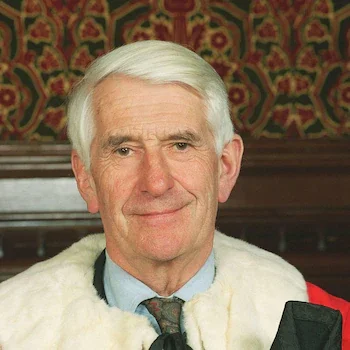
Lloyd had always stayed just ahead of Mustill as their parallel careers progressed, and had been the first to become QC, join the Bench, and advance to the Court of Appeal. But Mustill had narrowed the time-gap at each stage, and, at the last, he finally pulled well ahead: he was appointed a Lord of Appeal in Ordinary in early 1992, Lloyd not until late in the following year. The 'Times' obituarist rather sniffily suggested that "Lloyd's promotion to sit as a Law Lord in the highest Court in the land was an almost natural progression for a man whose legal career was marked by the effortless ease of a classical establishment background". Although it was not spelled out, there was perhaps in this an implied contrast with the case of Mustill, the self-declared simple Yorkshireman who came, if not exactly from nothing, from a less favoured background than Lloyd. And it is true that Mustill did make the greater mark on the law, both judicially and in his books. But it would be unfair to suggest that Lloyd did not merit his place in the Lords. He was a better lawyer than many of his predecessors, and he delivered important judgments on the scope of the concept of dangerous cargo under the Hague/Hague-Visby Rules and at common law (The 'Giannis NK' [1998] AC 605), general average, a subject which seldom gets as far as the Lords (The 'Bijela' [1994] 1 WLR 615), ship mortgages (The 'Maule' [1997] 1 WLR 528), damages for breach of contract when the cost of putting a defect right would exceed the economic benefit (Ruxley v Forsyth [1996] AC 344, and the consequences of termination of shipbuilding contracts (Stocznia Gdanska v Latvian Shipping [1998] 1 WLR 574).
Stocznia Gdanska revealed a spirit of independence in Lloyd's judicial personality. Robert Goff had fully analysed the issues in a judgment which is widely regarded as definitive, and Lloyd might easily have done nothing more than express his agreement, as the other three Law Lords did. But he delivered a separate judgment, setting out his own reasons for reaching the same conclusion. That spirit was apparent again in The 'Nicholas H' [1996] AC 211, in which Lloyd's four colleagues decided that a classification society which negligently approved a ship as fit to sail was not liable to plaintiffs whose cargo was lost when the ship sank on the voyage. Lloyd, who dissented, diplomatically suggested that the majority decision "would seem a strange result". He was a little less polite in his dissent in ICS v West Bromwich [1998] 1 WLR 896, a foundational case in the modern law of contractual construction, in which Lord Hoffmann held that it was permissible and correct to construe "any claim (whether sounding in rescission for undue influence or otherwise)" as though it read "any claim sounding in rescission (whether for undue influence or otherwise)". Lloyd remarked that "no principle of construction" permitted or justified such "creative interpretation". Away from commercial cases, Lloyd retained his interest in criminal law. He sat on more than fifty criminal appeals, and gave the leading judgment in R v Clegg [1995] 1 AC, which established the important point that a person who kills another by using excessive and unreasonable force in self-defence is guilty of murder, not merely of manslaughter. Lloyd also participated in cases about banking, employment, family law, planning, tax, trusts and miscellaneous other topics. In all, he sat in nearly two hundred and fifty House of Lords and Privy Council appeals in five years.
Lloyd retired at the end of 1998, a little before his seventieth birthday. Although no longer a paid Law Lord, he remained an active member of the House of Lords, speaking in debates and sitting on committees involved in various legal and ecclesiastical matters, until he finally retired in 2015. As a cross-bencher, he was expected to be politically neutral, and Lloyd showed how seriously he took this principle by castigating governments of both political persuasion with equal vigour. He attacked New Labour's plans, announced without consultation, to abolish the ancient office of Lord Chancellor. (The idea was watered-down, but not entirely dropped, and the LC ceased to be head of the judiciary.) And he lambasted the Conservatives' failure to get tackle the problem of indeterminate sentences, under which prisoners were held until they proved that they no longer posed a risk, which they could only do by completing rehabilitation courses which prisons had no capacity to provide. Lloyd's anger about the issue is captured by an audio-recording preserved on YouTube. He made national news headlines in 2004 when he conducted an inquiry into the health issues experienced by many British Gulf War veterans. The inquiry was entirely independent and unofficial, established on the initiative of Labour peer Lord Morris of Manchester. Unconvinced by government claims that the unusually high levels of serious illness among service personnel who had been exposed to a challenging cocktail of vaccines, pills, pesticides and fumigants was simply an unhappy co-incidence, Lloyd roundly declared that Gulf War Syndrome did exist, even if he could not precisely pinpoint a single cause.
Lloyd's charitable work also continued in his retirement. So did Jane's: she was awarded the MBE for services to charity in 2007.
Lloyd did occasionally manage to find time for pure pleasure and relaxation. There was always work to be done on the house, farm, and garden in Sussex. He and Jane were both classical music lovers (Lloyd played the piano) and concert goers. Almost inevitably, though, this pastime led to fresh responsibilities, when Lloyd was recruited as a trustee of Glyndebourne Opera and a director of the Royal Academy of Music. Like John Donaldson and Roger Parker, Lloyd was a skilled woodworker. This came in useful in the restoration of Ludlay: the replacement of one barn roof was all his own handiwork. And Lloyd always retained an affection for the classics at which he had excelled in his first year at Cambridge: he was a member of the Horation Society, read classical texts in the Greek and Latin original, and had a scaled-down replica of a Greek Temple lifted into place with heavy machinery in the garden.

Lloyd during his long and unusually active “retirement”.
The Lloyds had no children. This was a great sadness to them, although whether they could ever have found the time to raise a family must be questionable. As it was, they were often surrounded by numerous nieces, nephews, and godchildren, who they often took on skiing holidays.
As he entered his nineties, Lloyd remained sufficiently hale and active to accept an invitation to the dinner at the Guildhall to celebrate one hundred and twenty-five years of the Commercial Court. Sadly, when the event was postponed for over a year by lockdown, it was thought safer that he should not go, with Covid-19 still in circulation. During 2023 and 2024, he successively overtook Rayner Goddard, Brian Neill, and Robert Wright, all of whom had lived past ninety-four, to become the first (and, to date, only) Commercial Court Judge to reach his ninety-fifth birthday. He and Jane kept a flat in the Inner Temple, which they had taken on so that Lloyd could live close to the Courts during legal term, until 2023. They often stayed there to attend worship and musical events at Temple Church, and concerts at Wigmore Hall and other venues. A file found among Lloyd's papers after his death indicated that these jaunts up to London were sometimes followed by officious demands for congestion charge payments, which Lloyd vigorously contested in correspondence with the authorities.
Anthony John Leslie Lloyd died peacefully at Ludlay in December 2024, a few weeks short of twenty-six years after he had retired from the Bench. He was buried at St Michael's & All Angels in Berwick.